

march 2026 Newsletter.
Welcome to our newsletter, with all our updates and some helpful resources for you. In this edition we talk about Muscle Activation.
Remember, we are here to help you and you can contact us anytime.
Welcome to our
march newsletter
Hello Ocean therapy friends!!
Hello Ocean Therapy friends! 🎉 We’ve made it through what is hopefully the worst of the weather!
Spring must officially be here—I’ve ditched my Aquadry for dog walks, the tulips are in bloom, and the clocks will soon be springing forward. We can finally enjoy those longer, lighter evenings!
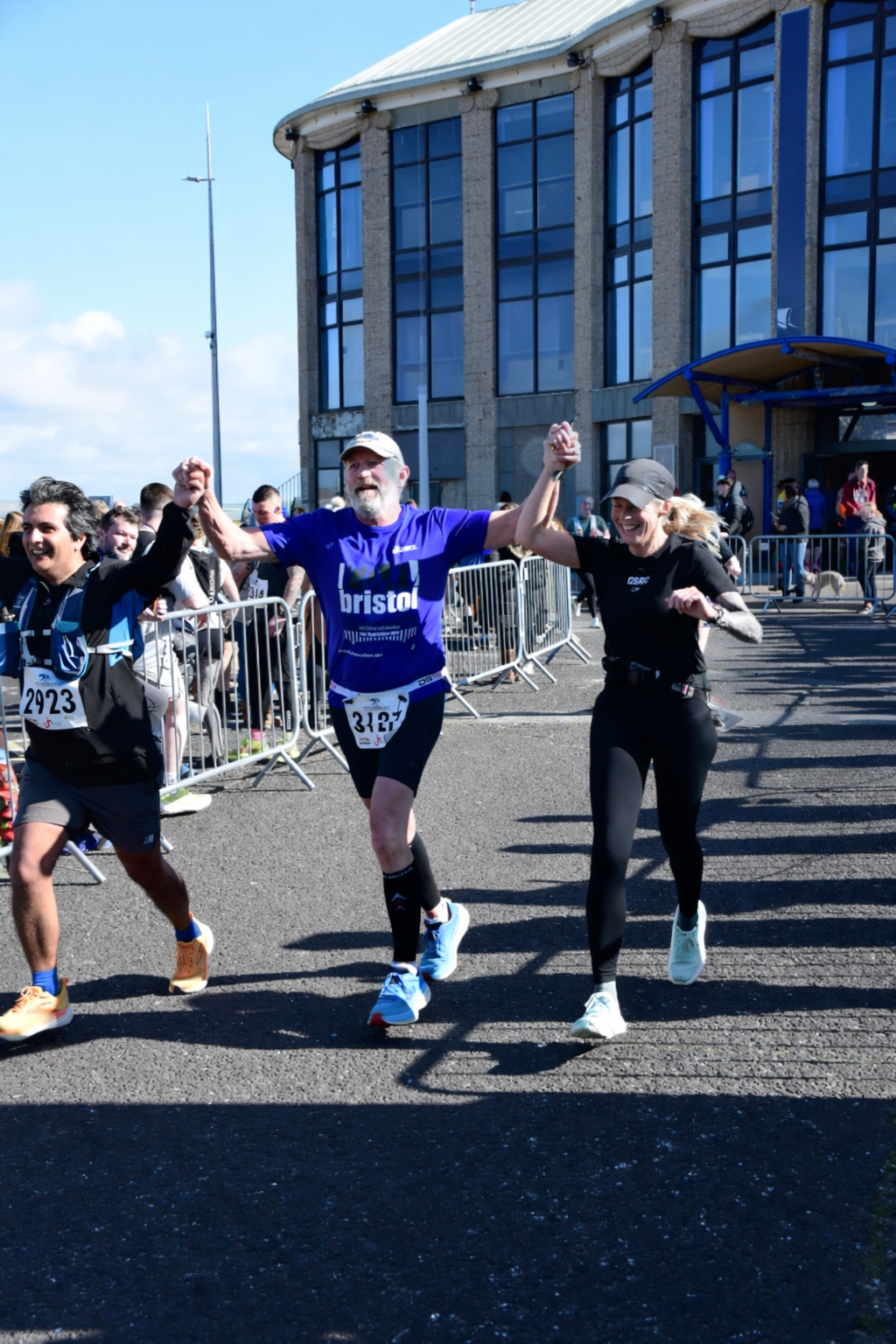
This month, we’d like to feature two of our patients, the amazing Claire Smith and her partner Martin, who both competed in this year’s Weymouth Half Marathon. Well done to everyone who took part—by all accounts, it was a fabulous sunny morning to take in the sights.
One more mention, and something a little different: one of our keen equestrian patients, Samantha Wood, has found herself featured in Country Life magazine! Samantha was asked to appear in this iconic publication after being spotted as the local owner of six geese.
She shares her yard—nestled in the beautiful village of Abbotsbury—with this gaggle of beauties, along with a horse, a pony, and her mischievous Border Collie, Blue. He’s a real cutie, full of character, and, as you can imagine, is often found perched on the roof of the stable block, keeping watch over the flock and checking out the number 53 Coaster bus as it idles past!
This month, we’re focusing on muscle activation and why it is so crucial for rehabilitation. As a large part of our work in the clinic involves deactivating painful trigger points, we thought you might find this information particularly helpful.
We’ve also included some useful patient resources at the bottom of this newsletter on shoulder impingement, an injury we see very frequently here at Ocean Therapy.

Stop Going Through the Motions
Why Muscle Activation Is Critical for Rehab, Prehab, and Performance
March is a great time to refocus — not just on lifting heavier or doing more, but on moving better.
One of the most overlooked (and most important) parts of training is muscle activation. This becomes non-negotiable when we talk about rehabilitation and prehabilitation.
Whether you're coming back from an injury, trying to prevent one, or simply want your body to last long-term — how your muscles fire matters more than how much weight you move.
Muscle Activation: The Foundation of Rehab and Prehab
Rehab and prehab aren’t about flashy exercises. They’re about:
Teaching the right muscles to turn on
Preventing compensation patterns
Restoring balance and control
After injury — or even long periods of poor movement — your body adapts.
Muscles that should be working often don’t fire correctly, while others take over to protect you.
If those patterns aren’t corrected:
Pain lingers
Injuries return
Strength plateaus
This is why simply “doing the exercise” isn’t enough.
Rehab Reality: Movement Without Activation Is Just Compensation
During rehab, the goal is not just movement — it’s intentional muscle recruitment.
If the target muscle isn’t firing correctly:
The joint doesn’t get proper support
Stress shifts elsewhere
Healing slows down
Your body is smart. It will always find a way to move — even if that way reinforces dysfunction.
Example: Glute Bridges in Rehab
Glute bridges are a staple in rehab and prehab programs — but only when done correctly.
What often goes wrong:
Hamstrings dominate
Lower back overextends
Hips lift without true glute engagement
Why this matters:
If the glutes don’t fire correctly:
Knees remain vulnerable
Hips stay unstable
Lower back keeps compensating
The fix:
At the top of the bridge:
Pause
Squeeze the glutes
Then squeeze again — slightly harder
Keep ribs down and core engaged
That extra squeeze ensures the right muscle is relearning its job.
Prehab: Protecting Your Body Before Injury Happens
Prehab is proactive rehab. It focuses on:
Improving joint stability
Enhancing muscle coordination
Preventing overuse and breakdown
Most injuries don’t happen because someone is weak —
they happen because muscles aren’t firing when they should.
Example: Face Pulls for Shoulder Health
Face pulls are commonly prescribed for shoulder rehab and prehab — but again, only if done correctly.
Common issues:
Arms dominate the movement
Upper traps shrug
Mid-traps and rhomboids stay inactive
If stabilisers don’t engage:
Shoulders remain unstable
Neck tension increases
Rotator cuff stress builds
The fix:
Instead of pulling with your hands:
Pull your shoulder blades together
Imagine pinching something between them
Pause and squeeze your upper back
Then squeeze again before returning slowly
This teaches the correct muscles to activate before stress occurs.
Why Activation Matters More Than Load
In rehab and prehab, more weight is rarely the answer.
Muscle activation:
Restores proper movement patterns
Improves joint alignment
Reinforces neuromuscular control
If you rush reps or rely on momentum:
The nervous system doesn’t relearn
Weak links stay weak
Pain patterns persist
Slow, controlled, intentional movement is how the body heals.
“Squeeze… Then Squeeze Again” — A Simple Rule
When you think you’re activating the muscle —
squeeze a little harder.
That second squeeze:
Confirms the muscle is firing
Eliminates compensation
Builds awareness and control
This is especially important for muscles that have been dormant due to:
Pain
Injury
Prolonged sitting
Train for Longevity, Not Just Today
Rehab and prehab aren’t optional — they’re investments in your future movement.
By focusing on muscle activation:
Injuries heal more effectively
Weak areas become resilient
Performance improves without sacrificing joint health
Whether you're rehabbing, prehabbing, or just training smarter this March:
Don’t just move. Don’t just lift.
Activate with intention — and make every rep count.
Book a Session
Book a session with Boris at Ocean Therapy
📞 01305 831726
Helping you move better.
Understanding Trigger Points
What They Are, How They Affect You & Why We Treat Them
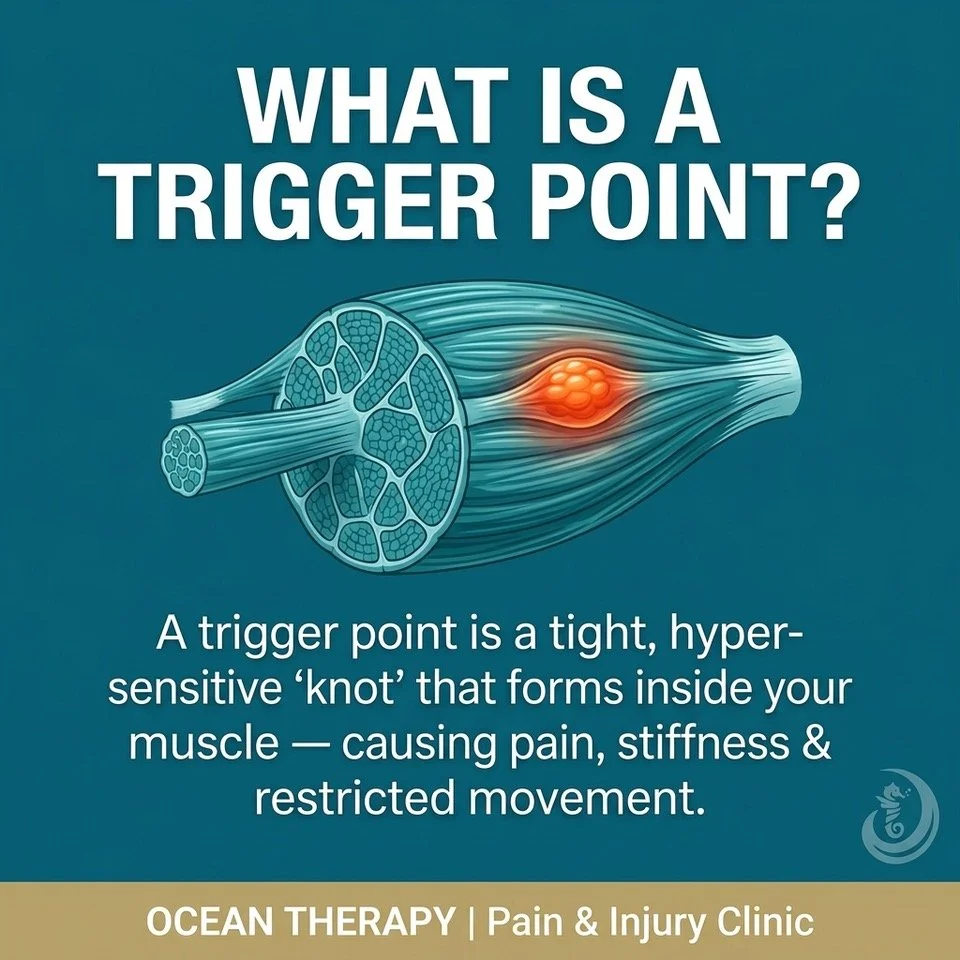
What Is a Trigger Point?
If you’ve ever felt a stubborn “knot” in your neck after a long day, or a dull ache in your shoulder that radiates — you’ve likely experienced a trigger point.
A trigger point is:
A hyperirritable spot within a tight band of muscle fibres.
These small nodules form when muscle fibres become stuck in contraction, creating:
Local tension
Tenderness
Pain (sometimes referred elsewhere)
Up to 85% of adults experience trigger-point-related pain at some point.
How Do Trigger Points Form?
Trigger points develop over time due to:
Poor posture
Repetitive movement
Injury
Stress
What happens in the body:
Muscles are overloaded
Excess acetylcholine is released
Fibres stay contracted
Blood flow is reduced
Waste builds up
Nerves become sensitised
This creates a self-perpetuating pain cycle.
Types of Trigger Points
🔴 Active — Constant pain (even at rest)
🟡 Latent — No pain unless pressed, but cause stiffness
🔵 Satellite — Spread to nearby muscles
🟠 Attachment — Found near tendons, may affect joints
How Trigger Points Affect You
🚶 Movement & Flexibility
Reduced range of motion
Stiff, restricted movement
🔄 Compensation Patterns
When one muscle isn’t working properly:
Others take over
New trigger points develop
Dysfunction spreads
Example:
Tight hips → altered pelvis → lower back pain
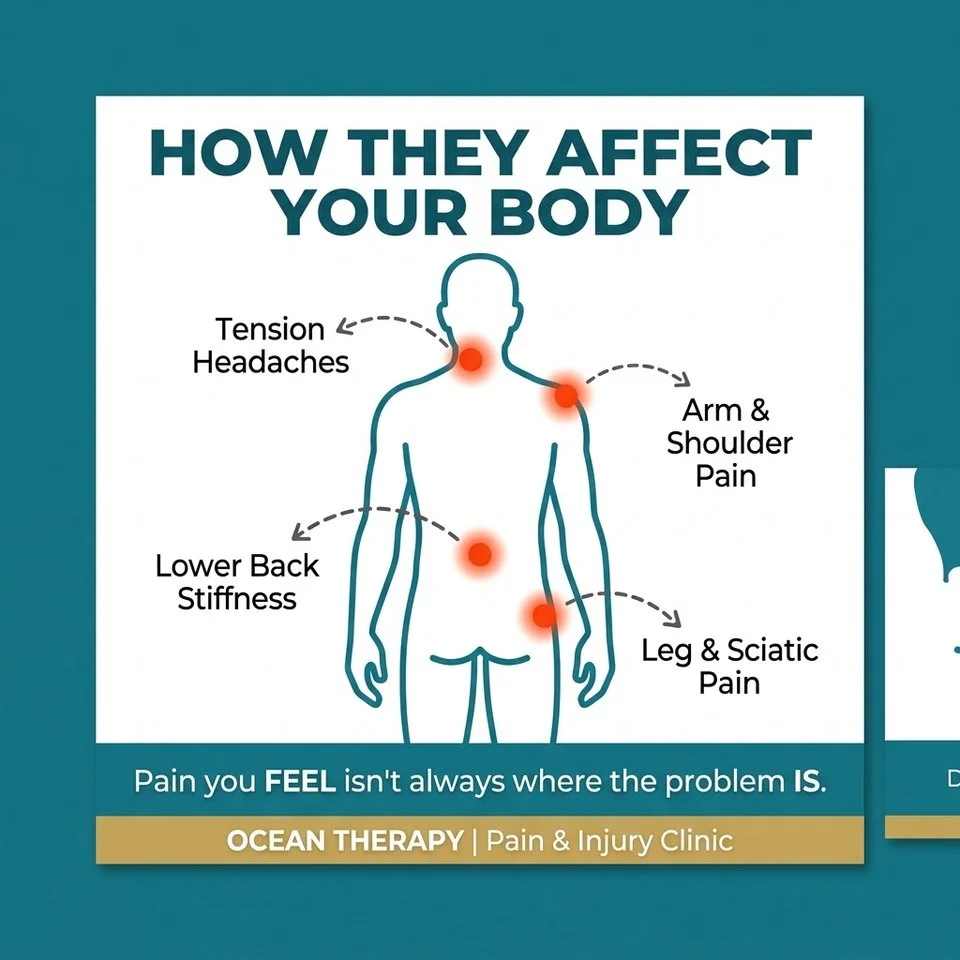
🧠 Referred Pain
Trigger points often send pain elsewhere:
Upper traps → headaches
Glutes → sciatica-like pain
Shoulder blade → arm pain
Around 74% of pain cases involve referred pain.
😴 Fatigue & Energy
Trigger points:
Increase nervous system load
Cause constant low-level strain
Lead to fatigue and mental drain
Why Early Treatment Matters
If untreated, trigger points can lead to:
Chronic pain
Central sensitisation
Increased pain sensitivity
What starts small can become much harder to resolve later.
Why We Treat Trigger Points at Ocean Therapy
At Ocean Therapy, treating trigger points is a cornerstone of our approach to musculoskeletal health — and for very good reason. We don’t simply aim to temporarily quieten the pain; our goal is to address the root cause, restore full muscle function, and prevent recurrence.
Our approach includes:
✅ Manual Therapy & Soft Tissue Release
✅ Dry Needling
✅ Myofascial Release
✅ Movement & Rehabilitation
✅ Postural & Lifestyle Assessment
We don’t just reduce pain — we restore normal function and prevent recurrence.
The Takeaway
Trigger points aren’t just “tight muscles” — they’re a real physiological issue that can affect:
Movement
Comfort
Performance
Quality of life
The good news?
With the right treatment at Ocean Therapy:
Pain can reduce quickly
Mobility improves
Normal movement returns
Don’t forget! we are selling our gift vouchers in the reception, call in to reception on: 01305 831726 for more information.

As always if you require any further advice or have any questions relating to this or any other injury’s or conditions, we are always available for a no obligation chat just call our receptionists on : 01305 831726 to arrange.
Warmest wishes, Samantha & Boris
🌅 Stay Connected 🌅
Follow us on social media for monthly movement tips, clinic updates, and inspiration from our amazing Weymouth community.
📍 OceanTherapy Soft Tissue Injury Clinic, Weymouth, Dorset 📞 01305 831726

Disclaimer: This content is designed for information and education purposes only and is not intended as medical advice. Always consult with a qualified healthcare provider before beginning any exercise program, especially if you have existing medical conditions or concerns.